Major Features of a Product Configurator (And How They Grow Ecommerce Sales)
Written by The Kickflip Team
October 15th, 2025
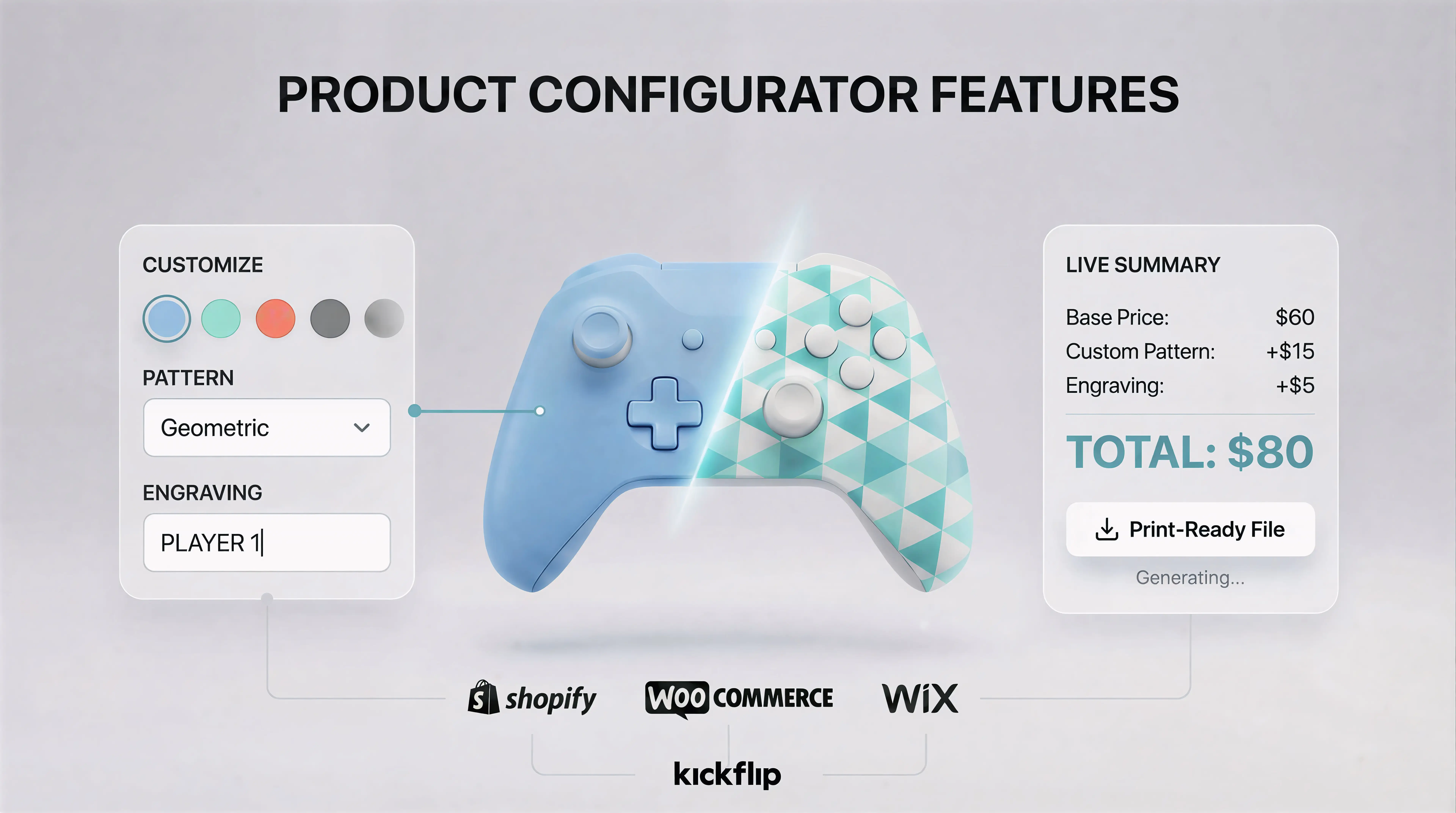
Table Of Contents
- Core Configuration Engine: Rules, Logic, and Data
- Visual Experience: Live Previews and Interactivity
- Pricing, Quotes, and Checkout Integration
- Simplified opps fulfillment
- Admin, No-Code Building, and Team Workflows
- Premium Storefront, Customer Experience & Revenue-Driving Features
- How to Evaluate Product Configurator Platforms (and Where Kickflip Fits)
- Transform Your Products with Intelligent Customization
- Frequently Asked Questions
Personalization has shifted from a nice-to-have feature to a business necessity. Modern consumers expect to customize products to their exact preferences, while businesses seek ways to increase conversion rates, boost average order values, and reduce return rates. This demand is particularly pronounced in D2C and B2B markets, where brands selling configurable or made-to-order products can capture significantly higher margins through customization.
A product configurator is a digital tool that empowers customers to customize products by selecting from predefined options while automatically enforcing valid combinations and displaying real-time updates. Unlike basic product variants, configurators handle complex customization scenarios across industries like apparel, furniture, equipment manufacturing, and branded merchandise. They integrate with ecommerce platforms like Shopify, WooCommerce, and Wix to create smooth, conversion-optimized experiences.
This guide is for ecommerce managers, brand owners, and operations leaders who want to understand the major features that make product configurators effective revenue drivers. You'll discover the core technical capabilities, visual experience components, pricing and integration features, production-ready outputs, and administrative tools that separate basic customization from enterprise-grade configuration solutions. You'll also see how platforms like Kickflip deliver these features through no-code solutions that reduce implementation complexity while maximizing business impact.
Core Configuration Engine: Rules, Logic, and Data
Rules-Based Configuration and Validation
At the heart of every effective product configurator lies a rules engine that enforces valid product combinations while preventing impossible or commercially unviable configurations. This central validation system ensures customers can only select compatible options, eliminating costly fulfillment errors and customer disappointment.
The rules engine handles multiple constraint types:
Physical compatibility
Example: Certain colors unavailable in specific sizes
Impact: Prevents impossible manufacturing scenarios
Component dependencies
Example: Wireless features require specific hardware
Impact: Ensures functional product delivery
Compliance requirements
Example: Regional safety standards or voltage requirements
Impact: Avoids regulatory violations
Commercial logic
Example: Premium materials only available with higher-tier packages
Impact: Protects margin structure
A custom furniture configurator might prevent customers from selecting a glass top with a base that cannot structurally support it, while a corporate apparel configurator ensures logo placement adheres to brand guidelines across different garment types.
Conditional Logic and Dependencies
Advanced configurators implement conditional logic that dynamically shows or hides options based on previous customer choices. This creates guided experiences that simplify complex product selection while enabling sophisticated bundling strategies.
Conditional logic enables several crucial capabilities:
Progressive disclosure: Only showing relevant options as customers make selections, reducing cognitive load
Mandatory add-ons: Automatically including required components when certain base options are selected
Mutually exclusive options: Preventing conflicting choices that could compromise product functionality
Smart defaults: Pre-selecting optimal configurations based on customer choices
The business impact extends beyond user experience. Conditional logic reduces configuration errors by up to 40%, accelerates order processing, and enables more complex product offerings that would be unwieldy with traditional variant management.
Product Data Structure and Scalability
Effective configurators require robust data architecture to manage attributes, options, and constraints across large product catalogs. The underlying data structure must accommodate thousands of possible combinations while maintaining performance and enabling rapid rule updates.
Scalable data management addresses several operational challenges:
Catalog growth: Supporting expanding product lines without performance degradation
Rule complexity: Managing interdependent constraints across multiple product attributes
Version control: Tracking changes to configurations over time for consistency
Global synchronization: Ensuring rule updates propagate across all customer touchpoints
As product lines evolve, this scalable foundation becomes crucial for maintaining competitive differentiation while controlling operational complexity.
Visual Experience: Live Previews and Interactivity
Real-Time Visual Previews
The visual experience separates premium configurators from basic customization tools. Real-time 2D and layered image previews that update instantly as customers make selections dramatically increase buyer confidence and reduce return rates by helping customers understand exactly what they're purchasing.
Visual configuration software enables multiple preview capabilities:
Material and color changes: Instantly applying different textures, finishes, and colors to product images
Text and logo placement: Real-time positioning of personalization elements with accurate sizing
Component visualization: Showing how different parts combine to create the final product
Multi-angle views: Displaying products from multiple perspectives to provide complete visual understanding
The business impact is substantial. Brands implementing live visual previews typically see 25-40% increases in conversion rates and 30-50% reductions in return rates, as customers develop clear expectations about their customized products.
Advanced Visualization and Performance
Modern configurators balance visual richness with performance, especially on mobile devices where over 60% of ecommerce traffic occurs. Advanced visualization features must load quickly while providing engaging, interactive experiences.
Key performance considerations include:
Image optimization: Using compressed, appropriately sized images (maximum recommended 1200x1200px) for fast loading
Progressive loading: Displaying base images immediately while loading customization layers
Mobile responsiveness: Ensuring touch-friendly interfaces with clear visual feedback
Accessibility compliance: Supporting screen readers and keyboard navigation for inclusive experiences
Platforms like Kickflip optimize performance by recommending specific image dimensions and compression techniques, ensuring configurators load quickly across devices while maintaining visual quality.
UX Best Practices for Configurator Interfaces
The interface design significantly impacts completion rates and customer satisfaction. Effective configurators balance comprehensive customization options with intuitive navigation that guides customers toward successful purchases.
Two primary interface approaches dominate the market:
Guided Step-by-Step Flows
Progress indicators showing completion status
Single-focus screens that prevent option overwhelm
Clear navigation between configuration steps
Ideal for complex products with many customization options
Freeform Configuration
All options visible simultaneously for quick comparison
Real-time preview updates with immediate feedback
Better for simpler products with fewer decision points
Enables rapid iteration and experimentation
Successful configurators also implement clear error states, contextual help text, and prominent calls-to-action that maintain momentum toward purchase completion.
Pricing, Quotes, and Checkout Integration
Real-Time Pricing and Margin Control
Dynamic pricing capabilities transform product configurators from simple customization tools into sophisticated revenue optimization engines. As customers select different materials, personalization options, or add-ons, the pricing updates instantly, providing transparency while protecting business margins.
Effective pricing engines handle multiple variables:
Base product cost
Example: Standard t-shirt: $15
Implementation: Fixed pricing foundation
Material upgrades
Example: Premium cotton: +$8
Implementation: Percentage or fixed markups
Personalization
Example: Custom embroidery: +$12
Implementation: Per-location or per-character pricing
Quantity discounts
Example: 50+ units: -15%
Implementation: Volume-based pricing tiers
Regional adjustments
Example: EU pricing: +20% VAT
Implementation: Geographic pricing rules
Advanced configurators also support complex pricing scenarios like tiered markups, bundled pricing for related options, and promotional pricing that automatically applies qualifying discounts.
Quote Generation for B2B and High-Consideration Purchases
For B2B sales and high-value customized products, Configure Price Quote (CPQ) functionality replaces immediate purchase with quote generation workflows. This approach accommodates longer sales cycles while capturing detailed customer requirements.
Kickflip's Configure Price Quote feature exemplifies modern CPQ implementation:
Quote request capture: Customers complete full configurations before requesting pricing
Approval workflows: Internal teams can adjust pricing before customer presentation
Professional quote documents: PDF generation for formal business presentations
Conversion tracking: Monitoring quote-to-order conversion rates for optimization
CPQ particularly benefits industries like corporate promotional products, custom equipment, and branded merchandise where bulk orders require approval processes and negotiated pricing.
Ecommerce and Payment Integration
Seamless integration with ecommerce platforms ensures configuration data flows accurately from customer selection through order fulfillment. This integration maintains the customization context while leveraging existing payment processing, inventory management, and customer service workflows.
Platform-specific integrations address unique requirements:
Shopify Integration: Native app marketplace distribution with automated product synchronization, cart integration, and order data capture that preserves all customization details.
WooCommerce Integration: WordPress-compatible plugin architecture that integrates with existing themes and maintains WooCommerce's flexible product management capabilities.
Wix Integration: Drag-and-drop compatibility that aligns with Wix's user-friendly website building approach while adding sophisticated customization capabilities.
These integrations ensure customization data, pricing calculations, and customer inputs transfer accurately to order management systems, enabling smooth fulfillment without manual data entry errors.
Simplified opps fulfillment
Order Data Capture and Automation
Effective product configurators bridge the gap between customer experience and operational execution by capturing all customization details in structured, actionable formats. This comprehensive data capture eliminates manual order processing while providing production teams with precise specifications.
Order data capture includes:
Selected options: Complete record of all customer choices with exact specifications
Customization inputs: Text entries, uploaded images, and placement instructions
Pricing breakdown: Detailed cost analysis for margin tracking and financial reporting
Production requirements: Materials, processes, and quality specifications
Timeline expectations: Customer delivery requirements and production scheduling needs
Automated data capture reduces order processing time by 60-80% while virtually eliminating costly fulfillment errors that result from manual interpretation of customer requirements.
Print-Ready and Manufacturing-Ready Files
Advanced configurators generate production-ready files that feed directly into manufacturing workflows, eliminating the traditional gap between customer orders and production execution. This capability is particularly crucial for on-demand manufacturing and personalized product fulfillment.
File generation capabilities include:
Print-ready PDFs: Vector-based files with proper resolution, color profiles, and bleed specifications
Manufacturing specifications: Technical drawings with dimensions, materials, and assembly instructions
Artwork positioning: Precise placement guides for logos, text, and decorative elements
Quality standards: Automated verification that outputs meet production requirements
Kickflip's file generation system exemplifies this integration by automatically creating print-ready files that maintain design accuracy while meeting commercial printing standards, reducing pre-production setup time and eliminating design interpretation errors.
Compliance, Localization, and Regional Rules
Global ecommerce requires configurators that handle regional variations in pricing, regulations, and technical requirements. Compliance management becomes particularly complex when selling configurable products across multiple markets with different standards.
Regional compliance features address:
Regulatory constraints: Safety standards, electrical requirements, and material certifications
Pricing localization: Currency conversion, tax calculation, and regional pricing strategies
Technical specifications: Dimensional limits, voltage requirements, and compatibility standards
Language adaptation: Translated option names, descriptions, and user interface elements
This compliance layer ensures products meet local requirements while maintaining consistent global brand experiences, reducing market entry complexity for international expansion.
Admin, No-Code Building, and Team Workflows
No-Code Configurator Builders
Modern product configurators democratize customization by enabling non-technical team members to create and manage sophisticated configuration experiences. Drag-and-drop editors empower Founders, marketers, product managers & designers to launch configurators without IT dependency.
No-code builders typically include:
Visual interface design: Intuitive tools for creating configuration steps and option layouts
Logic configuration: Point-and-click rule creation for dependencies and constraints
Asset management: Simple upload and organization systems for product images and materials
Preview capabilities: Real-time testing environments for validating configurations before launch
This approach reduces implementation timelines from months to weeks while enabling rapid iteration based on customer feedback and market requirements.
Versioning, Testing, and Iteration
Successful configurators require continuous optimization based on customer behavior and business needs. Advanced platforms provide sophisticated testing and versioning capabilities that enable data-driven improvements without disrupting live customer experiences.
Key versioning features include:
Staging environments
Capability: Test changes before production release
Business Value: Reduce deployment risk
Version rollback
Capability: Revert to previous configurations
Business Value: Minimize downtime impact
These capabilities enable continuous improvement cycles that systematically increase configurator effectiveness while maintaining operational stability.
Permissions, Collaboration, and Governance
Enterprise configurator implementations require robust governance frameworks that balance team collaboration with quality control. Role-based permissions ensure appropriate access while maintaining configuration integrity across complex organizational structures.
Governance features address:
Role-based access: Different permission levels for product, design, and operations teams
Approval workflows: Structured review processes for configuration changes
Change tracking: Audit trails that document all configuration modifications
Single source of truth: Centralized configuration management that prevents version conflicts
These governance capabilities become particularly important as configurator usage scales across multiple products, teams, and geographic markets.
Premium Storefront, Customer Experience & Revenue-Driving Features
Premium Storefront Experience
Modern configurators extend beyond functional customization to create premium brand experiences that justify higher price points and build customer loyalty. The storefront presentation becomes a crucial differentiator that communicates product value while guiding customers toward optimal selections.
Premium experience elements include:
On-brand theming: Customizable interfaces that seamlessly integrate with existing brand guidelines
Professional photography: High-quality product images that showcase customization options effectively
Mobile optimization: Touch-friendly interfaces designed specifically for smartphone shopping
These premium touches significantly impact customer perception, often justifying 20-30% price premiums while reducing price sensitivity for customized products.
Guided Selling and Recommendation Logic
Intelligent configurators help customers navigate complex options through guided selling features that recommend optimal configurations based on use cases, preferences, or popular combinations. This approach reduces decision paralysis while increasing average order values.
Guidance mechanisms include:
Preconfigured templates: Starting points for common use cases or customer personas
Smart recommendations: AI-driven suggestions based on customer selections and historical data
Popular combinations: Highlighting frequently chosen option sets to reduce decision time
Upsell integration: Strategic presentation of premium options and add-ons during configuration
Effective guided selling can increase average order values by 15-25% while improving customer satisfaction through reduced choice complexity.
Personalization Inputs and Uploads
Personalization capabilities transform standard products into unique customer expressions, creating emotional connections that drive loyalty and reduce return likelihood. Advanced input handling ensures personalization elements integrate seamlessly with base products while maintaining production feasibility.
Personalization features encompass:
Text customization: Names, numbers, messages, and custom copy with font and positioning control
Image uploads: Logo placement, photo integration, and artwork application with size and resolution validation
Design templates: Guided design tools that help non-designers create professional-looking customizations
Validation systems: Automatic checking of file types, dimensions, and quality to prevent production issues
Robust personalization inputs enable deeper customer engagement while maintaining operational efficiency through automated validation and file preparation processes.
How to Evaluate Product Configurator Platforms (and Where Kickflip Fits)
Key Questions to Ask When Choosing a Configurator
Selecting the right product configurator requires careful evaluation of features against specific business requirements and technical constraints. The decision framework should balance immediate needs with long-term scalability while considering total cost of ownership.
Critical evaluation criteria include:
Must-Have vs. Nice-to-Have Features
Visual preview requirements (2D vs. 3D based on product complexity)
Integration depth with existing ecommerce platform
Production workflow compatibility and file output requirements
Pricing complexity and real-time calculation needs
Technical Requirements
Platform compatibility and integration options
Performance standards for loading speed and mobile experience
Security compliance for customer data and payment processing
Scalability capacity for product catalog growth
Total Cost of Ownership
Initial setup and implementation costs
Ongoing subscription fees and transaction charges
Maintenance requirements and technical support needs
Training and change management expenses
Evaluating for Ecommerce: Shopify, WooCommerce, Wix and Beyond
Ecommerce platform integration depth significantly impacts implementation complexity and long-term operational efficiency. Native integrations provide smoother experiences while custom development offers greater flexibility at higher cost and complexity.
Platform-specific considerations:
Shopify Considerations
Product configurator for Shopify solutions should leverage Shopify's app ecosystem
Native cart integration and checkout flow preservation
Compatibility with existing Shopify themes and third-party apps
WooCommerce Evaluation
WordPress ecosystem compatibility and plugin management
Flexibility for custom PHP development and theme integration
Database optimization for large product catalogs
Wix Assessment
Drag-and-drop compatibility with Wix's design philosophy
App market integration and customer support alignment
Mobile responsiveness within Wix's responsive framework
How Kickflip Approaches These Major Features
Kickflip addresses the complete spectrum of product configurator requirements through an integrated platform designed specifically for ecommerce brands seeking to implement sophisticated customization without technical complexity.
Kickflip's comprehensive feature set includes:
No-Code Implementation: The intuitive custom product builder enables rapid configurator creation without developer dependency, reducing time-to-market from months to weeks.
Visual Excellence: Live 2D previews with real-time updates provide immediate customer feedback while maintaining fast loading speeds across devices and connection types.
Advanced Pricing: Dynamic pricing engines handle complex scenarios including material markups, quantity discounts, and geographic variations while maintaining margin protection.
Production Integration: Automated generation of print-ready files and comprehensive order data capture streamlines fulfillment workflows while eliminating manual processing errors.
Platform Integration: Native integrations with Shopify, WooCommerce, and Wix ensure seamless ecommerce workflow integration.
Kickflip has demonstrated significant business impact across diverse industries, with clients reporting 40-60% increases in average order values, 25-35% improvement in conversion rates, and 50-70% reductions in fulfillment errors. These results stem from Kickflip's focus on balancing sophisticated functionality with user-friendly implementation that enables rapid deployment and continuous optimization.
Transform Your Products with Intelligent Customization
Product configurators represent a fundamental shift in how brands can engage customers, increase revenue, and streamline operations. The major features we've explored work together to create experiences that drive measurable business results: rules-based validation and live visual previews, automated file generation and seamless ecommerce integration.
For ecommerce managers and brand owners ready to implement product customization, the key is starting with a platform that balances sophisticated capabilities with implementation simplicity. Kickflip's no-code approach enables rapid deployment while providing the advanced features needed for long-term success.
Whether you're looking to increase average order values, reduce return rates, or create more engaging customer experiences, Kickflip provides the comprehensive configurator platform designed specifically for modern ecommerce brands. The combination of intuitive management tools, powerful customization features, and seamless platform integrations enables you to focus on growing your business rather than managing technical complexity.
Ready to see how these configurator features can transform your product offerings? Explore Kickflip's capabilities and discover how leading brands are using intelligent customization to drive growth, improve margins, and create customer experiences that build lasting loyalty.
Frequently Asked Questions
What is a product configurator and how does it work?
A product configurator is a digital tool that allows customers to customize products by selecting from predefined options while automatically enforcing valid combinations. It works by presenting customers with customization choices, updating visual previews and pricing in real-time, and capturing all selections for production. The configurator integrates with your ecommerce platform to streamline the purchase process while generating production-ready specifications.
What are the most important features of a product configurator for ecommerce?
The most crucial features include: a rules-based configuration engine that prevents invalid combinations, live visual previews that show customizations in real-time, dynamic pricing that updates based on selections, seamless ecommerce platform integration, and automated generation of production-ready files. Additional important features include mobile optimization, guided selling capabilities, and comprehensive order data capture.
Do I need 3D visualization, or is a 2D product configurator enough?
For most ecommerce applications, high-quality 2D configurators provide excellent results at lower cost and complexity. 2D solutions load faster, work better on mobile devices, and are easier to maintain. 3D visualization is beneficial for complex products where customers need to understand spatial relationships or assembly, but 2D configurators often deliver better conversion rates due to superior performance and user experience.
How does a product configurator integrate with Shopify or WooCommerce?
Modern configurators integrate through native apps or plugins that connect directly with your ecommerce platform. For Shopify, configurators typically install through the app store and sync product data automatically. For WooCommerce, integration usually involves plugin installation and product synchronization. The integration captures all customization data, pricing, and customer inputs, then transfers this information seamlessly to your checkout and order management systems.
How can a product configurator increase conversion rates and average order value?
Product configurators increase conversion rates by reducing uncertainty through live previews and guided selling, while preventing invalid configurations that lead to cancelled orders. They boost average order value through strategic upselling during configuration, premium customization options, and the psychological ownership effect created by personalization. Studies show configurators typically increase conversion rates by 25-40% and average order values by 15-35% compared to standard product pages.
Future reading
What is a Product Configurator? (6 Real eCommerce Examples)
What Is a Configurator? A Guide for Modern Ecommerce
What Is Product Configurator Software? (And Why It Matters)
Share This article

Written by The Kickflip Team
October 15th, 2025
The Kickflip team is made up of ecommerce specialists, product experts, and engineers behind Kickflip, a product configurator platform for Shopify, WooCommerce, and Wix. Since 2010, we’ve helped thousands of brands scale personalized product experiences, from startups to Fortune 500 companies. On our blog, we share practical insights to help you improve the buying experience and grow your business with product customization.


Maarten Luyckx
Osaka World
The user-friendly interface of Kickflip, combined with excellent customer service, ensured that this project was brought to a successful and beautiful conclusion.
Shopify App Store
May 20, 2021

Marie-Laetitia Rossazza
My Dust Bag
It took me a long time to find the perfect customizer app, and I’m so happy to say that I finally did! Kickflip is truly the best app on the market. The front end and back end are excellent, and the team behind it is incredibly kind and helpful!
Shopify App Store
September 1, 2023

Brad Jurga
All-Star Sporting Goods
Kickflip made everything easy, from designing the builder all the way through launch. We’re designing truly custom equipment for elite baseball players and this platform allows us to have better engagement and excitement around our brand. We’re seeing an instant return.
Shopify App Store
June 16, 2025

Kasper Taylor
CodedInk
My experience with both the product and the support team has been fantastic. The user interface and user experience are excellent. The features are powerful, and the WooCommerce integration is seamless and easy to set up.
G2.com
June 16, 2025

Saber Naceur
Vinylacy
By far, and I truly mean it, the best customizer available on Shopify. It’s easy to understand and manage, offers options for all types of products, and works extremely well. On top of that, it looks beautiful and feels premium. Highly recommended.
Shopify App Store
December 17, 2022

Jesus Guillermo de León Pérez
Dismo
Kickflip is a fantastic tool. It’s super intuitive, easy to use, and packed with capabilities. You don’t have to be an expert or have experience with other products to get started. The support team is also great and very responsive.
Shopify App Store
July 10, 2024

Frieder Urban
Era of Arc
We were looking for an uncomplicated configurator that was quick and easy to set up, offered plenty of design options, and worked reliably with fast loading times. We tested many configurators on the market, and with Kickflip, we found exactly what we needed.
Shopify App Store
October 10, 2024

John Taggart
Jack Harry and Ollie
What a great addition to our business Kickflip has been. It’s been fantastic to offer our customers the ability to personalize their orders. The support has been excellent, and we especially love that the pricing is tied to our success as customers make purchases.
Shopify App Store
May 7, 2021

TJ Garske
The Net Return
Kickflip saves our team a ton of time by eliminating the need to create custom mockups for customers. Customers can build their product themselves and place an order instantly, without any back-and-forth.
G2.com
January 26, 2026

Amin Hasani
CURVD
After extensive research into product customizer tools, we chose Kickflip for many reasons. We don’t like complicating simple tasks for customers, and Kickflip helped us simplify the process and create a seamless customer experience.
Shopify App Store
July 29, 2025